How Do You Prep a Lot for a New House in Mississippi?
A raw lot becomes a house site in a set order. The survey, the permits, the 811 locate and, where there is no sewer, the septic evaluation come first. Then the machines clear the house site and build the pad.
One national cost guide puts site prep for a new house at $5,000 to $20,000 or more. Utilities and the house itself are separate costs.
These are market numbers, not our price list. We do site preparation for new house pads from Waynesboro across southeast Mississippi and southwest Alabama. Two Mississippi facts shape the schedule: the septic permit from the State Department of Health (MSDH) and the winter rain.
What are the steps from a raw lot to a house pad?
Each step sets up the next, so the order matters.
| Step | Who does it | What to know |
|---|---|---|
| 1. Survey | A licensed surveyor | The corners and the house spot get marked first. |
| 2. Address and septic evaluation | The county 9-1-1 office, then MSDH on a septic lot | The septic permit is tied to the plot plan. |
| 3. Permits | Your city or county, and MDEQ at 1 acre or more | Rules vary by town and county. |
| 4. Utility locate | Whoever does the digging, through Mississippi 811 | At least 3 working days before digging. |
| 5. Clearing and grubbing | The site prep contractor | Stumps and roots come out under the house and the drive. |
| 6. Pad and drainage | The site prep contractor | Fill is packed in layers and shaped to shed water. |
| 7. Driveway entrance | The site prep contractor, to the road owner’s rules | A road ditch may need a culvert. |
| 8. Utility lines | The water system, with trenches by the site prep contractor | On a septic lot, the meter waits on the MSDH permit. |
| 9. Foundation | The builder’s foundation crew | They need a finished pad and a drive their trucks can use. |
One national guide notes that forestry mulching does not suit a building site. So the house spot gets grubbed.
The pad is built up with fill and shaped so rain runs away from the house. A sloped lot may need cut and fill work with excavators and dozers first.
Why does the septic evaluation come before the dirt work?
In Mississippi, a house that may need septic starts with MSDH. The owner files a Notice of Intent with a fee. It needs a legal description and a plot plan of where the house goes.
An MSDH environmentalist then does a soil and site evaluation. MSDH’s form notes it is often called a perk test. The Permit/Recommendation that follows is good for two years.
MSDH voids that permit if extensive grading occurs or the house moves off the plot plan. So settle the house spot and the grading plan before the machines start. The same permit is what the water utility needs to set a new meter.
MSDH’s fee schedule lists $100 for the evaluation. The septic system is its own trade and its own bill, and MSDH lists certified installers. In Alabama, the county health department issues the septic permit after a soil test.
What permits does a new house site need?
It depends on where the lot sits, so check with the city or county first.
| Where the lot sits | What the rule says |
|---|---|
| Waynesboro | The city’s Building Department issues building permits. In a flood zone, a new home’s lowest floor must sit 1 foot above the base flood elevation. |
| Hattiesburg | Any development needs a building permit, and the city counts grading and excavating as development. Extensive grading may also need a Land Disturbance Permit. |
| Meridian | A Site Development Request comes before clearing, grading, filling or a driveway. No work is authorized until the Building Official signs it. |
| Laurel | A new building needs a permit, and the city fee list shows a Land Clearing Permit at $100. |
| Petal | The Building Department issues building permits and boring and digging permits. |
| Wayne County | Every home needs a 9-1-1 address from the county’s addressing office. |
| A mapped flood zone | Counties and cities in the flood insurance program must require a permit to build there. Wayne County and Waynesboro take part. |
| A county road | Call the county road department about the culvert before the drive goes in. |
| A state highway | MDOT has a permit application for a driveway onto a state highway. |
| A wetland | Fill in a federally regulated wetland takes a U.S. Army Corps of Engineers permit. |
| 1 acre or more disturbed | MDEQ’s construction stormwater permit applies. A smaller lot in a larger development can count too. |
The offices issue the permits, and we build the site to them.
When is the best time of year to build a house pad?
Waynesboro averages about 60 inches of rain a year in NOAA’s climate normals. December and January are the wettest months. October is the driest, with September and November next.
One common Wayne County soil holds a water table 1.5 to 3 feet down from January to March. Bibb is a common creek bottom soil here. Its water table sits within 8 inches of the surface 6 to 11 months a year. Keep the house out of the bottoms when the lot allows it.
Some local clay also swells when wet and shrinks when dry, which matters under a slab. So the drier fall months often suit pad work best, and we plan around the wet spells.
What does site prep for a new house cost?
National cost guides give these ranges, and the last row is MSDH’s own fee. A site visit sets the real price.
| Item | Range or fee |
|---|---|
| Site prep for a new house | $5,000 to $20,000 or more |
| Land clearing, per acre | $1,200 to $8,000 |
| Excavation for a new home’s foundation pad | $1,500 to $10,000 |
| Fill dirt, per cubic yard | $5 to $30 |
| Gravel driveway, per square foot | $4 to $10 |
| Culverts or drains for a driveway | $500 to $2,000 |
| Boundary survey, up to half an acre | $300 to $900 |
| Trenching for a water line | $800 to $3,000 |
| MSDH soil and site evaluation | $100 |
What moves the price on a Mississippi lot:
- Trees and stumps. A wooded lot costs more to clear than an open one. Our guide to land clearing cost per acre breaks it down by density.
- Fill. The pad’s size and height set how much dirt comes in. For example, a 50 by 60 foot pad built up 2 feet holds about 220 cubic yards. Loose dirt packs down, so plan on more. A common dump truck holds 8 to 12 cubic yards, so that is roughly 18 to 28 loads.
- Wet ground and clay. One national guide prices digging heavy or wet soil at $10 to $15 a cubic yard. Light soil runs $2.50 to $6.
- Distance. National guides price trenching by the foot. A house set far back from the road needs longer water and sewer line trenches.
What happens once the paperwork is in hand?
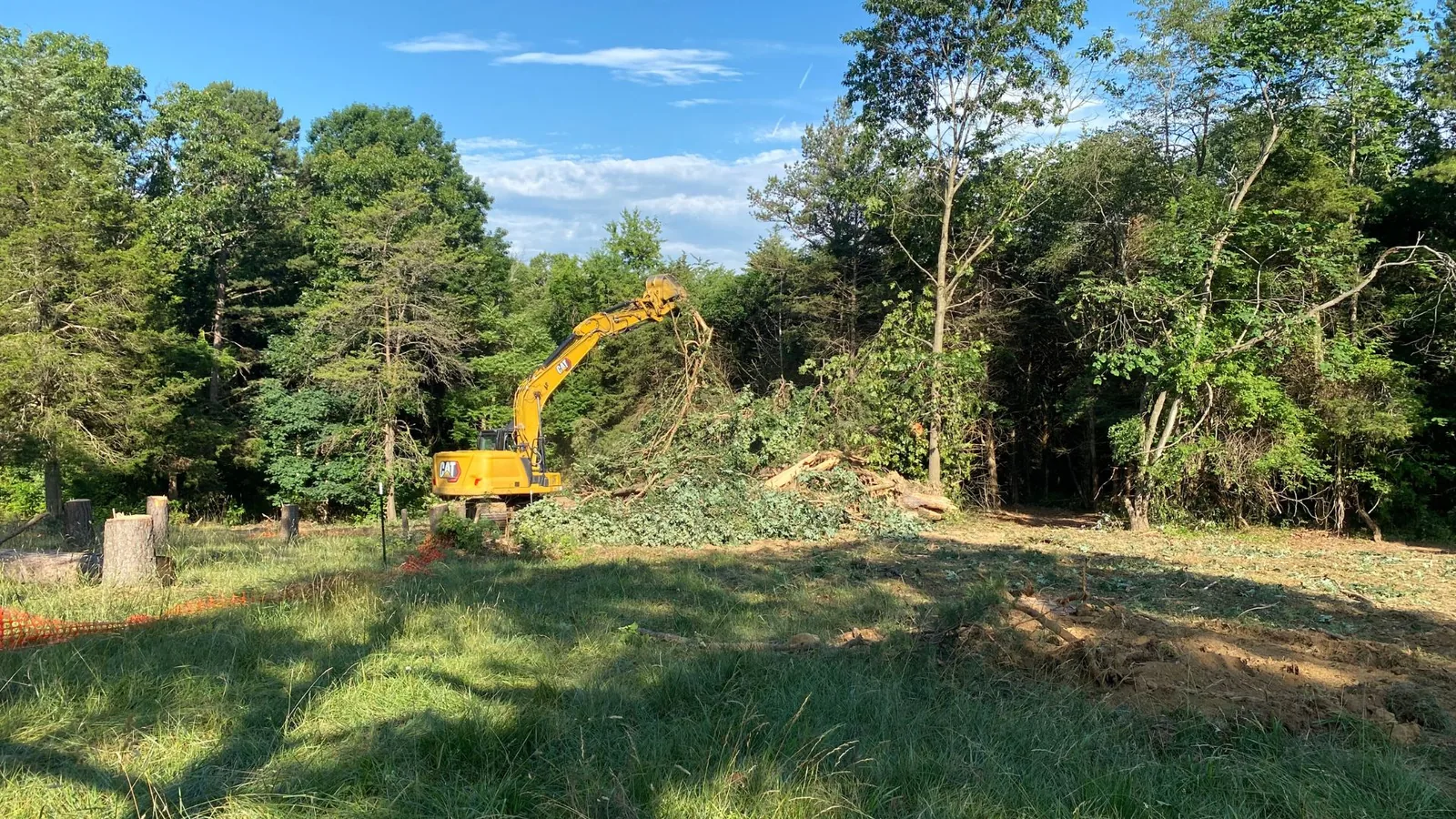
We clear and grub the house site and build the pad with fill hauled in on our own trucks. Then we cut in the drive and leave the site graded and ready for the foundation crew.
Send photos and a pin, or have us look at the site, and we put the quote in writing. See how we prep a house site, or call or text (601) 410-5339.