How Much Does Fill Dirt for a House Pad Cost in Mississippi?
National cost guides put fill dirt at about $5 to $30 a cubic yard. One guide prices a dump truck load of standard fill at $150 to $250, delivered within about 10 miles. Another puts the average delivered truckload at $842, with a typical range of $344 to $1,339. These are market numbers, not our price list.
Both guides say the price turns on the kind of dirt, how much you order and how far it travels. The dirt is only part of a pad’s cost. The rest is the work: clearing, hauling, packing and shaping the pad. This post is about the dirt pad a house, a mobile home or a shop sits on. The concrete slab on top is another trade’s job.
What does fill dirt cost per yard and per load?
These market ranges come from two national cost guides, so treat them as a starting point for southeast Mississippi.
| Fill dirt item | Market range | Source |
|---|---|---|
| Fill dirt, per cubic yard | $5 to $30 | First guide |
| Fill dirt, per cubic yard, delivered | $5 to $25 | Second guide |
| Fill dirt, per ton, delivered | $4 to $15 | Second guide |
| Structural fill, per cubic yard | $10 to $30 | Second guide |
| Truckload of standard fill, 10 to 14 yards | $150 to $250 | Second guide |
| Truckload of structural fill | $250 to $400 | Second guide |
| Average delivered truckload | $842 (typical $344 to $1,339) | First guide |
| Delivery billed by the hour | $65 to $100 an hour | First guide |
| One cubic yard you load and haul yourself | $15 to $25 | Second guide |
The truckload prices leave out spreading and assume a short haul.
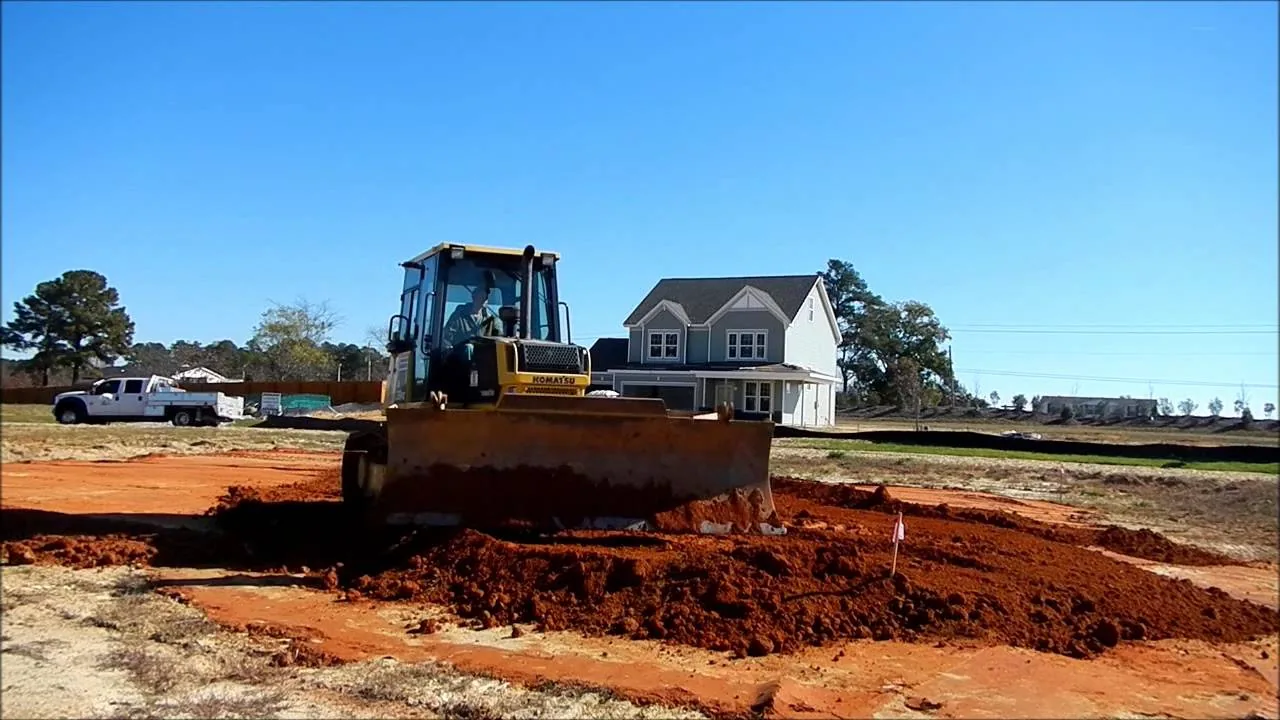
On a house pad job, we bring the fill in as part of the work. We clear the lot, haul the fill on our own trucks, then spread it and pack it in lifts. The finished pad is shaped to drain.
How much fill dirt does a house pad need?
Multiply the pad’s length, width and height in feet, then divide by 27 to get cubic yards. One national guide says the average commercial dump truck holds 8 to 12 cubic yards. Here is that math for a few sample pads.
| Pad size | Height | Cubic yards in the pad | Truckloads at 8 to 12 yards |
|---|---|---|---|
| 30 by 40 feet | 1 foot | about 44 | 4 to 6 |
| 30 by 40 feet | 2 feet | about 89 | 8 to 12 |
| 20 by 80 feet | 2 feet | about 119 | 10 to 15 |
| 40 by 60 feet | 1.5 feet | about 133 | 12 to 17 |
| 60 by 80 feet | 2 feet | about 356 | 30 to 45 |
| 60 by 80 feet | 3 feet | about 533 | 45 to 67 |
This is flat box math for the finished pad. Sloped sides add dirt, and the same guide says to add 5 to 10 percent for waste and spills. Loose dirt also packs down when it is rolled. So more yards get hauled than the finished pad measures, and how many more depends on the dirt.
Take the 30 by 40 foot pad built up 2 feet. Its 89 yards at $5 to $25 a yard delivered come to about $445 to $2,225 for the dirt alone. For every step from raw lot to finished pad, see our guide to site prep for a new house.
Which dirt makes a good house pad?
The dirt you want is structural fill or select fill: dirt that packs hard and drains. One cost guide describes structural fill as a mix of small stones, clay and enough sand to drain well.
Topsoil is the wrong dirt under a house. The national soil survey glossary says topsoil is ordinarily rich in organic matter. A cost guide adds that topsoil settles or erodes over time. Save it for the lawn around the pad.
Clay takes more care. The same glossary says soil that shrinks when dry and swells when wet can damage roads and building foundations. One cost guide says pure clay is not for construction because it will not drain groundwater. That is why wet, sticky clay makes a poor pad.
How is a house pad packed, and who tests it?
A pad goes up in layers called lifts. Each lift is spread and packed before the next one goes on. If your plans or your county set a lift depth or a density, that number rules.
For manufactured homes, HUD’s installation standard sets the bar. The foundation must sit on firm, undisturbed soil or on fill compacted to at least 90 percent of its maximum relative density.
Testing is a job for an engineer. HUD’s standard calls for a registered engineer, geologist or architect when the soil looks like peat, organic clay or uncompacted fill. On a job that needs a permit, one cost guide says a soil engineer checks the structural fill and writes a soil report. We build and pack the pad; the tests, when a job needs them, come from that engineer.
How high should a house pad sit in a flood zone?
Look at the flood map before you set the pad height. Communities in the federal flood insurance program follow a federal rule in zones AE, AH and the numbered A zones. A new home there needs its lowest floor at or above the base flood level. Manufactured homes placed in those zones have a similar rule.
Waynesboro’s flood ordinance goes further. Inside the city, in a flood zone with a mapped base flood elevation, a new home, manufactured homes included, needs its lowest floor one foot above that elevation. The city’s building page also asks for an elevation certificate in a FEMA flood zone.
The pad helps raise the house, but the rule measures the lowest floor, not the dirt. Rules differ by county and city, so call the floodplain administrator before the pad goes in. This is general information, not legal advice.
What about a mobile home pad?
A mobile home pad follows the same steps, with HUD’s installation standard as the yardstick. It calls for grass, roots, twigs and wood scraps removed where footings go. It also calls for the ground to slope at least one-half inch per foot away from the home for the first ten feet.
If the home will be skirted, the standard calls for a vapor retarder of at least six mil plastic over the ground under it. The installer sets and anchors the home. We build the pad it sits on.
What moves the price of a house pad?
- Haul distance from the pit. One guide’s truckload prices assume about 10 miles. Delivery billed by the hour runs $65 to $100, the other guide says.
- Room for the dump trucks. A delivery price often covers one dump on solid, dry ground at least 15 feet from overhead trees. A new lot may need a drive first, so call the county road department about a driveway culvert.
- Wet weather. One guide warns against driving a loaded dump truck across a yard when the ground is wet.
- Clearing first. Trees, stumps, roots and topsoil come off the pad area before the fill goes on.
- Cut and fill. On a sloped lot, dirt cut from the high side can fill the low side. Cut and fill can lower the number of loads hauled in.
Getting a house pad built near Waynesboro
Presto Contractors builds house pads, mobile home pads, shop pads and barn pads. We are based in Waynesboro in Wayne County and work about 70 miles out across southeast Mississippi and southwest Alabama. One company handles the job, from the first cut to the finished pad.
See our site preparation work, or call or text (601) 410-5339. We look at the site, or you send photos and a pin, and we put the quote in writing.